Not every widely-starred open-source project is something a business should reach for, and MediaCrawler is the clearest example we've covered so far. It's a genuinely popular tool — over 61,000 GitHub stars — for pulling posts, comments, and creator data from Xiaohongshu (RED), Douyin, Kuaishou, Bilibili, Weibo, Baidu Tieba, and Zhihu. It's also a tool whose own maintainer explicitly restricts it to learning and research use, prohibits commercial use in its license terms, and links directly to a public repository of web-scraping legal cases in China as a warning to anyone considering using it otherwise. That combination — real technical popularity and an explicit "don't build a business on this" disclaimer from the author — is worth understanding in detail before any team gets curious about it.
How It Actually Works
The technical premise is genuinely clever, and it's worth understanding on its own terms. Most social platforms protect their APIs with signed requests — every call includes a cryptographic signature generated by obfuscated, frequently-changing JavaScript running in the browser. The traditional way to scrape a platform like this is to reverse-engineer that JavaScript: painstaking, breaks every time the platform ships an update, and is the main reason building a reliable scraper for a major social app is a real engineering project rather than a weekend script.
MediaCrawler sidesteps that entirely. It uses Playwright to drive a real browser, logs in once, and saves that authenticated browser context. From then on, it doesn't need to know how the signature algorithm works — it just asks the real, already-logged-in browser page to generate a valid signature for it via a JS expression, the same way the platform's own frontend would. No cryptography to reverse, no algorithm to keep re-breaking after every platform update. That's the core insight, and it's the reason the project has stayed viable across years of anti-bot changes on the platforms it targets, while algorithm-reversing scrapers tend to break constantly.
What Actually Running It Looks Like
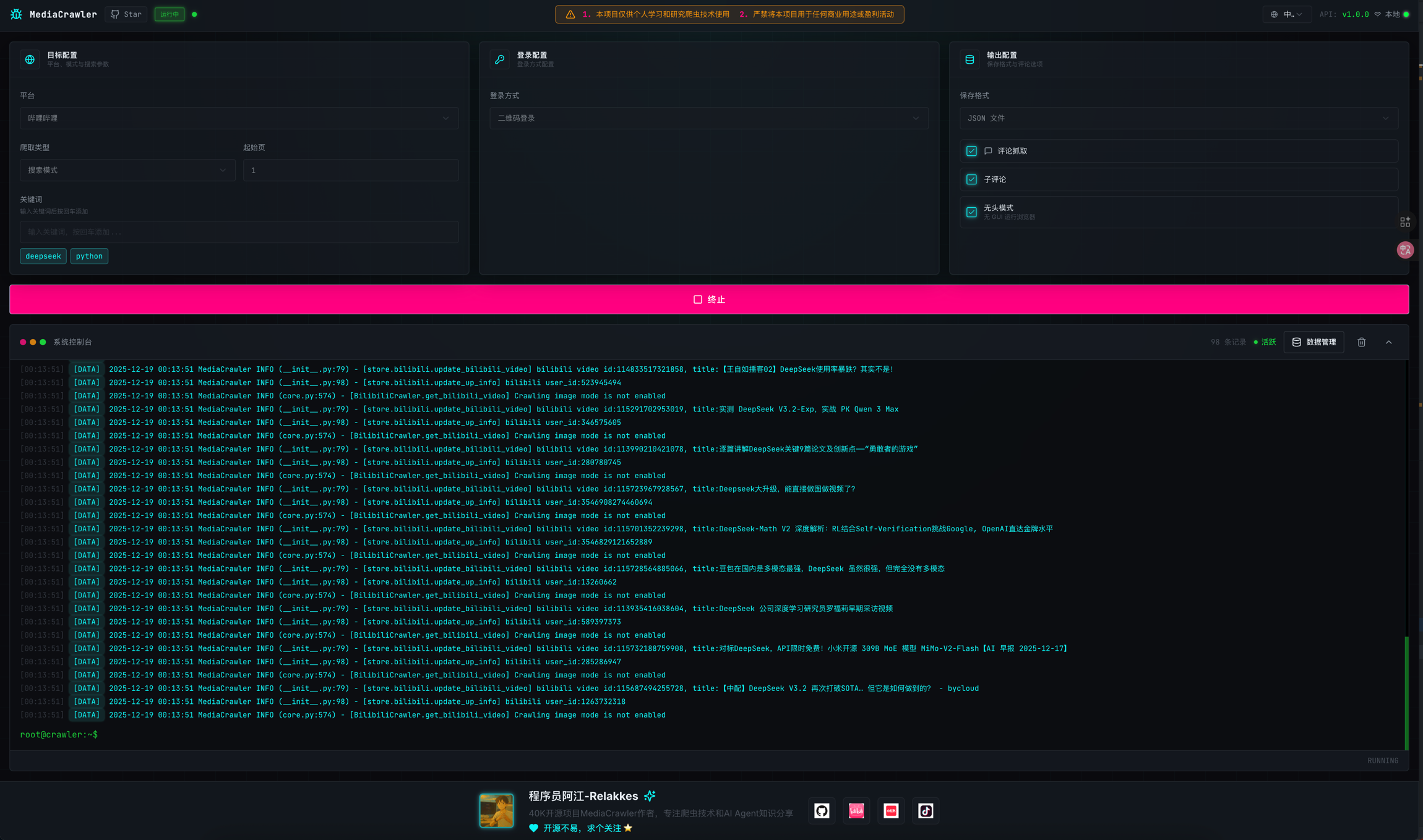
The setup is more involved than a typical scraper library, and the friction itself is informative. It expects uv for Python dependency management, Node.js 16 or newer (Douyin and Zhihu specifically need it), and — in its default configuration — a real, already-installed Chrome browser (version 144 or newer) running with remote debugging enabled on port 9222. That last part is the more interesting design choice: rather than launching a fresh, unmarked Playwright browser instance from scratch, the default mode connects to Chrome over the Chrome DevTools Protocol and rides on the browser's existing cookies, login state, and extensions. The project's own docs frame this directly as a way to reduce the platform's risk-control detection, since a browser with real history and a real profile behind it doesn't look like a bot the way a bare automation instance does. A standard Playwright-only mode is available as a fallback via a config flag, but CDP-against-real-Chrome is the path the project steers users toward.
Once running, collected data can land in CSV, JSON, JSONL, Excel, SQLite, or MySQL — a broader set of output targets than most single-purpose scrapers bother supporting, which again points toward the project's stated identity as something to study the architecture of, not just run.
What It Actually Covers
The feature set is broad and consistent across all seven supported platforms: keyword search, scraping a specific post by ID, pulling nested (secondary) comments, scraping a creator's full homepage, reusing cached login sessions across runs, routing traffic through an IP proxy pool, and generating a word-cloud visualization from collected comments. A separate closed-source "Pro" version, sold by the same author, adds resume-on-failure, multi-account rotation, and removes the Playwright dependency entirely — which tells you plainly where the maintainer draws the line between the free educational tool and something built for sustained, larger-scale operation.
The Part That Actually Matters: Read the License
This is the section that matters more than the architecture, and it's worth being direct about it rather than treating it as a footnote.
MediaCrawler's own README states, in its own disclaimer, that the project exists strictly as "a technical research and learning tool," that it is "strictly prohibited from being used for any illegal purposes or non-learning, non-research commercial activities," and that users bear full legal responsibility for how they use it. It specifically calls out compliance with China's Cybersecurity Law, and even references its Counter-Espionage Law, as laws a user needs to consider — language you don't see attached to a typical open-source scraping library, and a strong signal about how seriously the maintainer takes the legal exposure here. The README also links directly to a public collection of real criminal and civil web-scraping cases in China as a cautionary reference.
None of the platforms MediaCrawler targets permit this kind of access in their terms of service. Scraping a platform that requires a login, using a saved session to keep bypassing anti-bot protections, and extracting user-generated content and comments at scale runs directly against the terms nearly every major social platform enforces — and increasingly, against data protection law wherever the platform's users are located, since comments and profile data are personal data under most modern privacy regimes. A tool being popular and technically well-built does not change what a target platform's terms of service, or applicable law, actually say.
Where This Actually Gets Used
Understanding the real use cases helps separate the legitimate motivations from the risky ones:
- Academic and independent research. Studying platform dynamics, discourse patterns, or misinformation spread on Chinese social platforms, where the project's own "learning and research" framing genuinely applies.
- Personal projects and technical learning. The project is explicitly positioned, including by its own author, as a way to study browser-automation-based scraping architecture — a legitimate reason to read the code even if you'd never run it against a live account.
- Social listening and brand monitoring — the risky one. This is the use case that pulls businesses toward tools like this, and it's exactly the use case the project's license prohibits. Wanting to track brand mentions or competitor activity on Xiaohongshu or Douyin is a completely reasonable business need; using an unlicensed scraper explicitly marked "non-commercial use prohibited" to do it is not the way to meet that need.
What to Use Instead for Business Needs
If the actual goal is social listening, competitive monitoring, or campaign measurement on Chinese platforms, there are paths that don't carry MediaCrawler's legal exposure:
- Official platform APIs and creator/business tooling. Douyin, Xiaohongshu, and Weibo all offer business-facing APIs and ad-platform data access for verified accounts — more limited than a scraper, but licensed and stable.
- Licensed social-listening vendors. Commercial social-listening and market-intelligence platforms that specifically cover the Chinese social landscape maintain their own compliant data agreements with the platforms, which is exactly the operational overhead a scraper is trying to skip — legitimately, in this case.
- A general-purpose, ToS-respecting scraping API for anything outside login-gated social platforms. For public, non-authenticated web content, a tool like Firecrawl is a meaningfully different risk profile — it isn't designed around defeating login-gated anti-bot protections on specific platforms, and it defaults to respecting
robots.txt.
Practical Takeaway
MediaCrawler is worth knowing about as a genuinely interesting piece of engineering — the login-state-reuse trick is a smart way to sidestep a real technical problem, and it's a large part of why the project has stayed relevant. But it's a case where the right business takeaway isn't "how do we use this," it's "this exists, it's popular, and it's exactly the kind of dependency a legal or security review should catch before it ends up in a production pipeline." Any team whose roadmap involves social data at scale should be having the compliance conversation — API access agreements, data protection obligations under regimes like India's DPDP Act or the EU framework — before evaluating any specific tool, not after.
Teams building AI-driven marketing or social monitoring tooling who need a compliant data pipeline — official APIs, licensed data partnerships, or scraping architecture that actually respects target platforms' terms — can get hands-on architecture help from Woyce Technologies.
FAQ
What is MediaCrawler?
MediaCrawler is an open-source Python tool that scrapes posts, comments, and creator data from Chinese social media platforms — including Xiaohongshu, Douyin, Kuaishou, Bilibili, Weibo, Baidu Tieba, and Zhihu — using a saved, logged-in browser session to avoid reverse-engineering each platform's request-signing algorithm.
Is it legal to use MediaCrawler?
The project's own license and disclaimer restrict it to non-commercial learning and research use, and its README explicitly warns about legal risk under Chinese law, including citing web-scraping criminal cases. Scraping login-gated social platforms also typically violates those platforms' terms of service regardless of jurisdiction. It is not a tool a business should deploy for commercial data collection.
Can I use MediaCrawler for business social listening?
No — that use case is specifically what the project's license prohibits. Businesses that need social listening or brand monitoring on Chinese platforms should use official platform APIs or licensed social-listening vendors instead.
How is MediaCrawler technically different from a typical scraper?
Instead of reverse-engineering each platform's cryptographic request-signing algorithm — which breaks every time the platform updates it — it drives a real logged-in browser session via Playwright and asks that authenticated session to generate valid signatures directly, sidestepping the reverse-engineering problem entirely.
Is MediaCrawler the same as Firecrawl?
No. Firecrawl is a general-purpose web scraping API aimed at public, non-authenticated content, built for commercial and AI-agent use, and defaults to respecting robots.txt. MediaCrawler is purpose-built to access specific login-gated social platforms and is explicitly licensed for non-commercial research use only — a fundamentally different risk profile.
What should a business do instead of using tools like this?
Use each platform's official business or developer API, or work with a licensed social-listening or market-intelligence vendor that maintains compliant data-access agreements with the platforms directly. The compliance and legal review that a scraper skips is exactly what those paths are paying for.
What does MediaCrawler need installed to actually run?
The uv Python package manager, Node.js 16 or newer for the Douyin and Zhihu crawlers specifically, and — in its default configuration — a real installation of Chrome (version 144+) running with remote debugging enabled, since the default mode connects to an existing Chrome session over the Chrome DevTools Protocol rather than launching a fresh automated browser.
Why does MediaCrawler connect to an existing Chrome browser instead of launching its own?
Its own documentation frames this as a way to reduce a platform's bot-detection risk: a browser carrying real cookies, login history, and extensions doesn't present the same fingerprint as a bare, freshly-launched automation instance. A standard, self-launched Playwright mode exists as a fallback via a config setting.
Where can MediaCrawler save the data it collects?
CSV, JSON, JSONL, Excel, SQLite, or MySQL — a wider set of storage targets than most single-purpose scraping tools support.
What's the difference between MediaCrawler and MediaCrawlerPro?
MediaCrawlerPro is a separate, closed-source, paid product by the same author. It adds resume-on-failure crawling, multi-account and IP-proxy-pool rotation, drops the Playwright dependency entirely, and is pitched partly as a better architecture to study — but it doesn't change the underlying licensing risk of scraping these platforms commercially, since it's a different product with its own terms.