
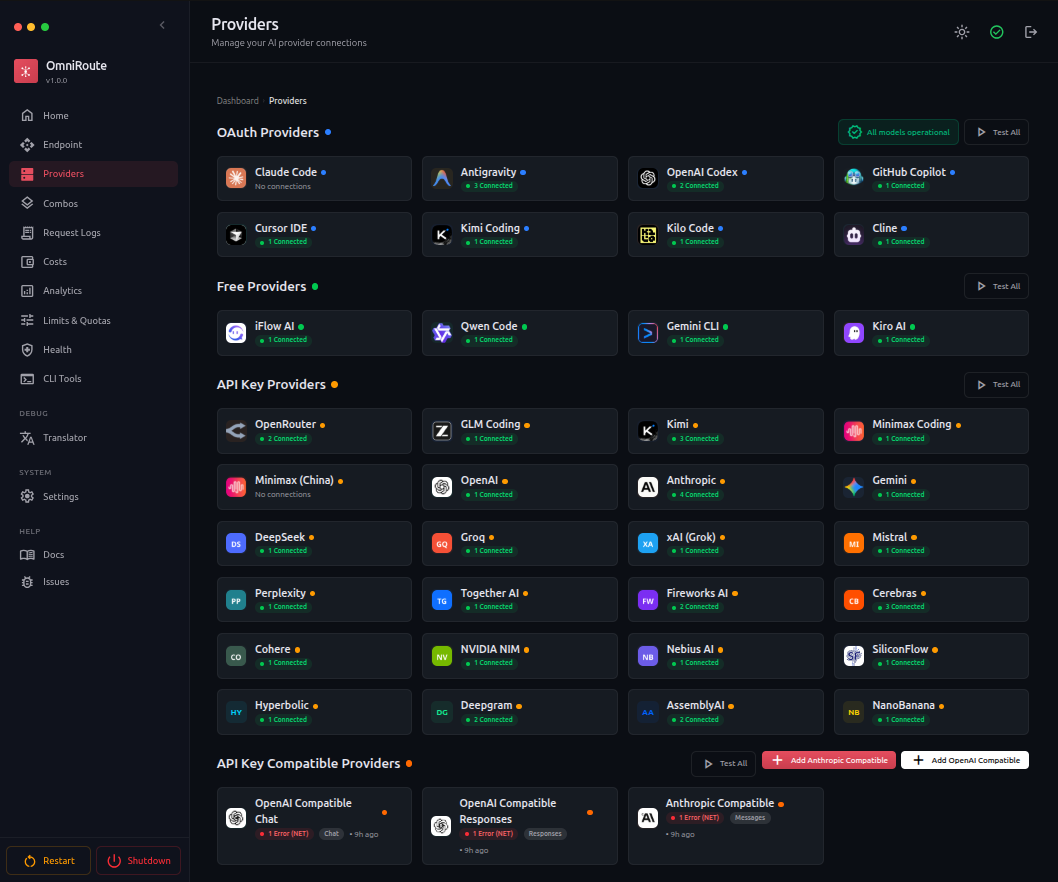
Anyone running several coding agents in parallel eventually hits the same wall: rate limits. Claude Code, Codex, and Cursor each burn through provider quota fast once you're running more than one session, and stitching together free tiers across a dozen different providers by hand — different SDKs, different auth, different limits — is its own chore. OmniRoute is built around that specific problem: a single gateway endpoint that fronts 290+ AI providers, tracks which free tiers you actually have quota left on, and falls back automatically when one runs dry.
What It Actually Does
OmniRoute sits between your coding agent and the model provider as a proxy that speaks the API shapes those tools already expect, so Claude Code, Codex, Cursor, Cline, Copilot, and similar tools can point at it as a single endpoint instead of being configured against each provider individually. From there it handles the parts that get tedious to manage by hand:
- Quota-aware routing across providers. It tracks documented free-tier limits across dozens of provider pools and routes a request to one with capacity remaining, falling back automatically rather than surfacing a rate-limit error to the agent mid-task.
- Token compression. A layered compression approach (the project calls it RTK + Caveman compression) is applied to requests to reduce token usage, which matters directly for anyone paying per token on the providers that aren't free.
- 19 routing strategies. Beyond simple failover, the routing layer supports multiple strategies for how to pick a provider for a given request — useful when cost, latency, and specific model capability all pull in different directions for different tasks.
- MCP and A2A support. It exposes itself as an MCP endpoint and supports agent-to-agent protocols, so it plugs into an existing agent tooling setup rather than requiring a bespoke integration.
Failure Handling Is Three Separate Layers, Not One Retry Loop
The routing logic doesn't just retry blindly when something fails — the documented resilience model splits failure handling into three independent layers, each scoped to a different blast radius. A provider-level circuit breaker trips only on 408s and 5xx responses, with thresholds that vary by how you're authenticated (three failures for OAuth, five for API-key auth, two for local providers), and resets through a half-open probe rather than snapping back to fully trusting a provider that just failed; while it's open, the combo reroutes to the next provider automatically. Below that, a connection-level cooldown handles a single failing key or account — exponential backoff with jitter against thundering-herd retries, honoring a Retry-After header when a provider sends one, with success clearing the error state — so one cooling-down key doesn't take sibling keys in the same pool down with it. The narrowest layer is per-model lockout: a 429, a local 404, or a mode denial locks out just that specific model rather than the whole provider connection. Splitting failure handling this way is a meaningfully more careful design than a single global retry-and-fallback loop, since it means one bad model or one expired key doesn't have to escalate into abandoning an entire provider.
A Real CLI Sits Behind the Gateway
Beyond the HTTP endpoint, OmniRoute ships a command-line interface with a wide command surface — omniroute serves the gateway and dashboard, omniroute chat opens an interactive terminal chat client, omniroute setup runs a guided first-run wizard, and omniroute doctor diagnoses provider, port, and native-dependency problems. A remote mode extends the same CLI to control a gateway running elsewhere: omniroute connect <host> exchanges a password for a scoped access token saved locally as a named context, after which commands like omniroute models list or omniroute configure codex run against that remote server instead of localhost. Tokens can be minted with read, write, or admin scope for different machines, and process-spawning routes stay loopback-only regardless of how the CLI is connected — a reasonable constraint given what a misconfigured remote-controlled gateway could otherwise do.
Deployment Options Go Well Beyond a Single Server
OmniRoute is built to run in more places than a typical self-hosted gateway. A global npm install (npm install -g omniroute) works on any OS; a multi-arch Docker image supports both AMD64 and ARM64, which extends to Raspberry Pi and other ARM servers; an Electron build produces a native desktop app with a system tray on Windows, macOS, and Linux; and it runs on Android through Termux with no root required, intended to stay running continuously on a phone. It's also installable as a PWA directly from a browser for an offline-capable, installable experience without any of the above. Package-manager installs are available too, including pnpm and an Arch Linux AUR package that registers a systemd user service. That range matters less for a typical single-developer setup than it does for anyone trying to keep one gateway instance available across several machines and platforms without standing up separate infrastructure for each.
Token Compression Is a Multi-Engine Pipeline
The "RTK + Caveman compression" framing undersells the scope of what's actually running: token compression is implemented as a twelve-engine pipeline, and RTK and Caveman are two named engines within it alongside others including LLMLingua-2 (running as a MobileBERT ONNX model for learned, content-aware compression) and additional engines for structural and glyph-level compression. Output styles and an adaptive dial give per-request control over how aggressively compression is applied, rather than a single fixed setting applied uniformly to every request regardless of content. The practical implication is the same as before — lower token costs on any provider billed by usage — but the mechanism is a stack of purpose-built compressors rather than one general-purpose trick.
The Security Architecture Is Worth Actually Reading
For a tool whose entire job is sitting between your coding agent and the model providers it talks to, what matters most isn't the feature list — it's how seriously the project treats the traffic and credentials passing through it. On that front, OmniRoute's documented security model is genuinely substantive: a request pipeline that runs through CORS checks, an authorization pipeline, and guardrails that include PII masking and prompt-injection detection before hitting rate limiting and circuit breakers. Authentication covers JWT-based dashboard login, HMAC-signed API keys, and OAuth 2.0 with PKCE across 13 supported provider integrations. The repository also runs secret-scanning and container-vulnerability tooling as part of its CI pipeline — the kind of engineering discipline that's easy to skip and genuinely reassuring to see present in a project handling API credentials.
Self-Hosted vs. the Hosted Endpoint
This is the decision that actually matters most before adopting it, and it's worth being deliberate about rather than defaulting into whichever path the quickstart nudges you toward. OmniRoute is MIT-licensed and fully open source, which means self-hosting it is a real option, not just a theoretical one — running your own instance means your agent traffic and credentials never leave infrastructure you control. Using the maintainer's hosted endpoint instead is faster to get started with, but it means routing your coding agent's prompts and provider credentials through a third party's infrastructure, which is a meaningfully different trust decision than running open-source code you've reviewed on your own servers. Treat that choice the way you'd treat it for any proxy sitting in front of API credentials: self-host for anything you wouldn't want to depend on someone else's uptime and trust model for.
Practical Implications
- If rate limits are the actual bottleneck, not raw model capability, this addresses that directly — quota-aware failover across many providers is a real answer to "my agent stopped working because I hit a limit mid-task."
- The free-tier aggregation is genuinely useful for prototyping and personal use, where stacking multiple providers' free quotas meaningfully extends how much you can do before paying for anything.
- For production or team use, self-hosting is the more defensible default given the credential-proxying nature of the tool — evaluate it the way you would any gateway sitting in front of API keys, not as a drop-in convenience layer.
- This is an extremely fast-moving project. Release notes show hundreds of commits and PRs per cycle — a sign of real, active engineering, but also a reason to pin versions deliberately rather than tracking the latest release blind in anything you depend on.
Practical Takeaway
OmniRoute is solving a real, specific pain point — provider rate limits and the tedium of manually juggling free tiers across a growing list of AI coding tools — with a level of routing and security engineering that goes well beyond a simple proxy script. The open question for any team isn't whether the tool works, it's whether the hosted convenience is worth the trust trade-off versus self-hosting a MIT-licensed, security-conscious gateway you can actually audit. For teams building on LLM APIs at any real scale, that's a decision worth making explicitly rather than defaulting into.
Teams evaluating gateway and routing architecture for AI coding tools — including the self-host-versus-hosted trade-off — can get hands-on help from Woyce Technologies.
FAQ
What is OmniRoute?
OmniRoute is an open-source AI gateway that routes requests from coding agents like Claude Code, Codex, and Cursor across 290+ AI providers, aggregating free-tier quota and automatically falling back to another provider when one runs out of capacity.
Is OmniRoute free to use?
The software itself is MIT-licensed and free, self-hostable at no cost. It also aggregates the documented free tiers of many AI providers, though the specific free capacity available depends on those providers' own terms and can change over time.
Should I self-host OmniRoute or use the hosted version?
For anything beyond casual personal use, self-hosting is the safer default, since the tool sits in front of your API credentials and agent traffic. The hosted endpoint is faster to start with but means routing that traffic through third-party infrastructure rather than servers you control.
Does OmniRoute work with Claude Code and Cursor?
Yes — it's designed to front tools including Claude Code, Codex, Cursor, Cline, and GitHub Copilot as a single gateway endpoint they can be pointed at instead of configuring each provider separately.
What is the token compression feature in OmniRoute?
OmniRoute applies a layered compression technique to reduce token usage on requests passing through the gateway, which lowers cost on any provider you're paying for by usage.
Does OmniRoute support MCP?
Yes — it exposes an MCP-compatible interface as well as agent-to-agent (A2A) protocol support, so it can integrate with existing agent tooling rather than requiring a custom integration layer.
What routing strategies does OmniRoute support?
Nineteen, covering different priorities: simple ones like priority order and round-robin, cost-aware strategies like cost-optimized (minimize price per request) and headroom (prefer the provider with the most remaining quota), and latency-aware options like power-of-two-choices load balancing. They can be mixed per step inside a routing "combo," or you can skip configuration entirely and use one of the built-in auto variants (auto/coding, auto/fast, auto/cheap, and others) that score connected providers live.
Does OmniRoute have a command-line interface?
Yes — beyond the HTTP gateway, it ships a CLI (omniroute, omniroute chat, omniroute setup, omniroute doctor) plus a remote mode that lets you control a gateway running on another machine using scoped access tokens.
Can OmniRoute run on a Raspberry Pi or a phone?
Yes. It has native ARM64 support for Raspberry Pi and ARM servers, and it runs on Android through Termux without root access. It's also installable as a PWA and as a Docker image built for both AMD64 and ARM64.
How does OmniRoute handle a provider failing mid-request?
Through three separate layers rather than one retry loop: a provider-level circuit breaker that trips on repeated 5xx/408 errors and reroutes to the next provider, a connection-level cooldown for a single failing key with exponential backoff, and a per-model lockout that blocks just one failing model without dropping the whole provider connection.